Traumatic Brain Injury Attorneys Lenawee County
Organize the evidence and coverage questions for traumatic brain injuries in Lenawee County. Free case review through our Ann Arbor office.
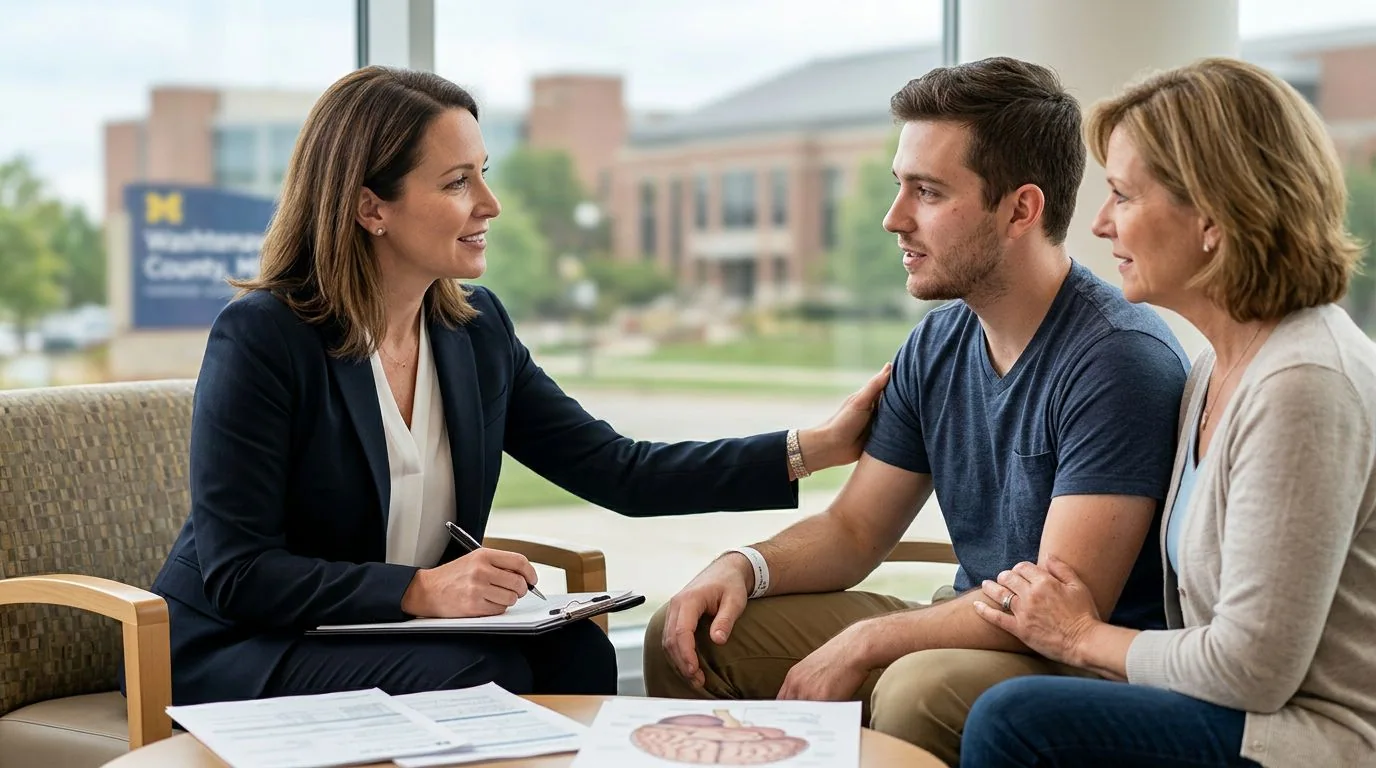
When a Lenawee County resident has a traumatic brain injury, the legal file needs to explain more than the day of the accident. Changes in attention, judgment, independence, and the ability to work may become clear only through ongoing records. Our attorneys represent injured people from our Ann Arbor office and help families document the practical effect of the injury.
Building a usable history when care involves several providers
A family in Adrian or another Lenawee community may have records from emergency treatment, rehabilitation, and later consultations. Organizing those records by date helps show what changed, which care was recommended, and why an insurer’s explanation may not tell the whole story. If the Sheriff’s Office investigated the event, its records-request guidance is a starting point for obtaining that agency’s report.
- List every treating provider and the reason for each visit. Include referrals and recommended care that an insurer has not authorized.
- Keep insurance denials with the corresponding bill or treatment request. Note the stated reason rather than treating all denials as the same dispute.
- Record the help family members provide, such as supervision, transportation, or assistance with daily tasks, and distinguish it from ordinary household routines.
- Preserve examples of pre-injury work, school, and independent activities. A before-and-after comparison should describe the actual person, not a generic list of symptoms.
Preparing the evidence for your claim
Keep initial and follow-up assessments, symptoms, work restrictions and observations from people familiar with daily functioning. Preserve the injury mechanism and treatment timeline rather than relying on a single test or scan alone.
Securing Lifetime Care and Compensation
Severe brain injuries often require attendant care, home modifications, and ongoing therapy for the rest of a person's life. Michigan's no-fault system can cover much of this, but only if the claim is properly documented and aggressively pursued. We fight for both the no-fault benefits and the third-party damages our clients need.
A published Michigan case result
$2,000,000 — February 2020 confidential settlement for first-party no-fault benefits. The defendant insurance company denied coverage for automobile insurance benefits arising from a car accident where the plaintiff suffered a severe traumatic brain injury. The defendant insurer also agreed to the reinstatement of all future no-fault benefits.
Read more in our verdicts and settlements. This is a reported result from the location described above, not a prediction for your claim. Past results do not guarantee future outcomes. Each case is decided on its own facts.
Record resources and next steps
If court proceedings already exist, Lenawee County Circuit Court information can help identify the relevant court record. It does not determine where a new claim should be filed.
Use the Lenawee County resource hub for local record routing and consultation planning, and the traumatic brain injuries practice guide for the broader claim explanation.
Discuss your claim
Logeman & Iafrate, P.C. serves Michigan injury clients from 2950 S. State Street, Suite 400, Ann Arbor, MI 48104. Call (734) 994-0200 or request a free consultation. Describe the incident, available records and any insurer correspondence. Confirm consultation arrangements before traveling.
Our published verdicts and settlements identify the matters described there. Read the claim type and venue as stated; a result does not establish local experience in another place or predict another case’s outcome.
Frequently Asked Questions: Traumatic Brain Injuries
My CT scan was normal. Can I still have a brain injury?
Yes. Mild traumatic brain injuries often do not show on standard CT scans yet cause serious, lasting symptoms. We use neuropsychological testing and specialized imaging, along with expert testimony, to prove these injuries.
The insurer says my symptoms are from a pre-existing condition. What can I do?
This is a common denial tactic. Michigan law allows recovery when an accident aggravates a pre-existing condition. We work with medical experts to separate accident-related effects and counter the insurer's argument.
Will no-fault cover long-term attendant care?
It can. Michigan no-fault may cover attendant care, home modifications, and ongoing treatment, but insurers often resist. We document the need and fight for those benefits, including future care.
How long do I have to bring a brain injury claim?
Generally three years for a personal injury claim and one year to claim no-fault benefits. Because TBI symptoms can be delayed, contact an attorney as soon as possible.
Was the published $2 million brain-injury settlement a case?
The firm’s published summary does not identify a county. We present it as an example of the firm’s Michigan no-fault work, not as a Lenawee County result.
Awards and Honors


We Stand with You through the Hardest Times, Advocating Vigorously for Your Rights.
At our personal injury law practice, we are prepared to handle claims involving car, truck, bus, bicycle, and pedestrian accidents; slip-and-falls and other premises liability claims; product liability claims; claims for compensation for brain and spinal cord injuries; and claims and lawsuits for wrongful death.
We help clients in Ann Arbor, Detroit and throughout Michigan recover the benefits they need and deserve. Our commitment to service is absolute. Please feel free to contact our firm at any time for advice or help with your personal injury claim.
What Our Clients Say About Us
Cases won, lives changed, and we are happy to have helped each one of our clients.


Schedule a Free Case Review with a Lawyer
Don't face this alone. Let us review your case and show you what's possible. We never charge legal fees unless we recover damages on your behalf and the initial consultation is free as well. Reach out to us today.