
Rideshare Accident Injury Lawyers Wayne County, MI
Organize the evidence and coverage questions for rideshare accidents in Wayne County. Free case review through our Ann Arbor office.
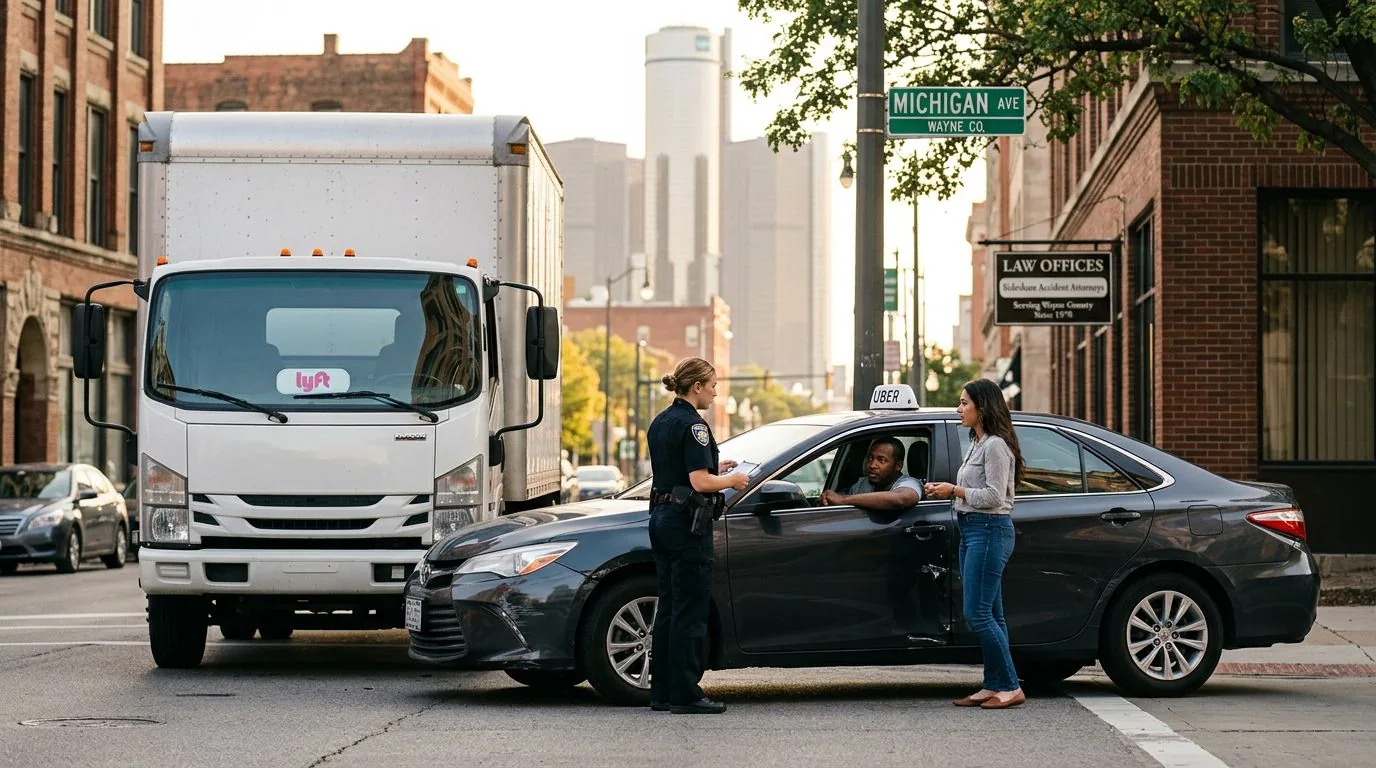
Rideshare accidents in Wayne County can involve several record sources and insurance questions. Start with the incident location, available reports and any insurer correspondence. The guidance below connects those details with the evidence needed to review the particular claim.
Why Rideshare Accident Cases Are Different
Rideshare crashes aren't like typical car accidents. Multiple insurance policies may apply depending on what the driver was doing when the crash occurred. Was the app on? Was there a passenger in the car? Had the driver accepted a ride request? Each scenario triggers different coverage, and insurance companies exploit this complexity to deny legitimate claims.
Both Uber and Lyft carry substantial liability insurance, but accessing those policies requires proving the driver was actively working at the time of the crash. We investigate every detail to establish which coverage applies and hold all responsible parties accountable.
Understanding Insurance Coverage Rideshare Accidents
Rideshare insurance coverage operates in phases:
- App off: Only the driver's personal auto insurance applies. Most personal policies exclude rideshare activity, leaving injured passengers with limited options.
Michigan's no-fault system adds another layer. As a passenger, you're entitled to Personal Injury Protection (PIP) benefits from either your own auto policy or a relative's policy you live with. If you don't have access to no-fault benefits, the rideshare driver's policy or the rideshare company's policy may cover your medical expenses and wage loss.
Common Causes of Rideshare Accidents
Rideshare drivers face unique pressures that increase accident risk:
- Distracted driving: Constantly checking the app for ride requests, following GPS directions, and communicating with passengers diverts attention from the road.
- Driver fatigue: Many rideshare drivers work long hours or drive after working another job, leading to dangerous fatigue.
- Inexperienced drivers: Some rideshare drivers lack professional driving experience and may not know Wayne County roads well.
- Aggressive driving: The pressure to complete rides quickly and accept new requests encourages speeding and risky maneuvers.
- Poor vehicle maintenance: Unlike commercial vehicles subject to regular inspections, rideshare vehicles may have deferred maintenance issues.
Injuries We See Rideshare Crashes
Rideshare accidents cause the same serious injuries as any motor vehicle crash:
- Traumatic brain injuries and concussions
- Spinal cord injuries and paralysis
- Broken bones and fractures
- Soft tissue injuries, whiplash, and herniated discs
- Internal organ damage
- Lacerations and scarring
- Psychological trauma and PTSD
As passengers, you have little control over the crash and often don't see it coming. Rear-seat passengers face particular risk because vehicles often lack adequate rear safety restraints.
Your Rights as an Injured Passenger
Michigan law protects injured passengers. You didn't cause the accident, and you shouldn't bear the financial burden. You have the right to:
- File for no-fault PIP benefits covering medical expenses, wage loss, and replacement services
- Pursue a third-party liability claim against the at-fault driver
- Seek compensation from the rideshare company's insurance if their driver caused the crash
- Recover damages from other negligent drivers who contributed to the collision
Even if you were sharing the ride with friends or family, you can still pursue full compensation. Your relationship with other passengers doesn't limit your legal rights.
What Compensation Can You Recover?
Rideshare accident victims in Wayne County may recover multiple types of compensation:
No-fault PIP benefits cover your medical expenses, 85% of lost wages, replacement services for household tasks you can't perform, and modifications to your home or vehicle if you suffer permanent injuries.
Third-party liability claims against the at-fault driver can provide compensation for pain and suffering, excess medical costs beyond your PIP coverage, full wage loss including future earning capacity, and other damages not covered by no-fault benefits.
To pursue a third-party claim, your injuries must meet Michigan's serious impairment threshold—an objectively manifested impairment of an important body function that affects your general ability to lead your normal life. Our attorneys have extensive experience proving threshold injuries and maximizing third-party recoveries.
Why Insurance Companies Fight Rideshare Claims
Insurance companies see opportunity in the confusion surrounding rideshare accidents. They know most injured people don't understand which policy applies, so they deny claims hoping you'll give up.
- Arguing the driver's app was off, limiting coverage to the driver's inadequate personal policy
- Claiming your injuries don't meet Michigan's threshold for pain and suffering compensation
- Delaying investigations to pressure quick, low settlements
- Disputing the severity of your injuries or suggesting they're unrelated to the crash
- Shifting blame between multiple insurance carriers to avoid responsibility
Save trip confirmations, app screenshots, driver and vehicle details, and the report number. Record whether a trip had been requested or was underway rather than assuming coverage from a company logo alone.
Steps to Take After a Rideshare Accident
The actions you take immediately after a rideshare crash can significantly impact your claim:
- Seek medical attention immediately. Even if you feel fine, some injuries don't show symptoms right away. Documentation of immediate medical care strengthens your claim.
- Report the accident through the app. Both Uber and Lyft have in-app accident reporting features. Use them to create an official record.
- Call police. A police report provides crucial documentation of the crash, especially regarding fault.
- Document everything. Take photos of the vehicles, your injuries, and the accident scene. Collect contact information from witnesses and other drivers.
- Don't give recorded statements. Insurance adjusters will contact you quickly. Politely decline to give recorded statements until you've spoken with an attorney.
- Preserve the trip record. Screenshot or save your trip details from the app, including pickup and drop-off locations, driver information, and timestamps.
- Contact an experienced rideshare accident attorney. The sooner we can begin investigating your claim, the stronger your case becomes.
Record resources and next steps
For a traffic incident, consult Michigan State Police’s crash-report guidance and the investigating agency identified in the report.
Use the Wayne County resource hub for local record routing and consultation planning, and the rideshare accidents practice guide for the broader claim explanation.
Discuss your claim
Logeman & Iafrate, P.C. serves Michigan injury clients from 2950 S. State Street, Suite 400, Ann Arbor, MI 48104. Call (734) 994-0200 or request a free consultation. Describe the incident, available records and any insurer correspondence. Confirm consultation arrangements before traveling.
Our published verdicts and settlements identify the matters described there. Read the claim type and venue as stated; a result does not establish local experience in another place or predict another case’s outcome.
Frequently Asked Questions About Rideshare Accidents
What should I do immediately after a rideshare accident?
Seek medical attention even if you feel fine, report the accident through the rideshare app, call police to document the crash, take photos of vehicles and injuries, collect witness information, and contact an experienced rideshare accident attorney before giving any recorded statements to insurance companies. Preserving your trip record from the app is also crucial.
Whose insurance pays for my injuries after a Uber or Lyft crash?
Keep treatment records, bills, work restrictions, pay information and recommendations for future support. The review should distinguish documented losses, available coverage and disputed issues; another person’s verdict is not a value for this claim.
Can I sue if I was injured as a passenger in an Uber or Lyft?
Yes. As an injured passenger, you can pursue no-fault benefits for medical expenses and wage loss, plus file a third-party liability claim against the at-fault driver for pain and suffering if your injuries meet Michigan's serious impairment threshold. You may also have claims against the rideshare company's insurance depending on the circumstances.
What if the rideshare driver's app was off when the accident happened?
If the app was off, only the driver's personal auto insurance applies. Most personal policies exclude rideshare activity, leaving you with limited coverage. However, we investigate thoroughly to determine the driver's status at the time of the crash. Insurance companies often claim the app was off to avoid paying from the larger rideshare policy. We gather evidence including app records, GPS data, and driver statements to prove which coverage applies.
How long do I have to file a rideshare accident claim?
You must file your no-fault claim within one year of the accident to preserve your PIP benefits. For third-party liability claims against the at-fault driver, Michigan's statute of limitations is generally three years from the date of the accident. However, consulting an attorney immediately ensures you meet all deadlines and preserve crucial evidence while it's still available.
What compensation can I recover after a rideshare accident?
You may recover no-fault PIP benefits covering medical expenses, 85% of lost wages, and replacement services. If your injuries meet Michigan's threshold, you can also pursue third-party claims for pain and suffering, full wage loss including future earning capacity, excess medical costs beyond PIP coverage, and other damages. The amount depends on the severity of your injuries and the insurance coverage available.
Awards and Honors



We Stand with You through the Hardest Times, Advocating Vigorously for Your Rights.
At our personal injury law practice, we are prepared to handle claims involving car, truck, bus, bicycle, and pedestrian accidents; slip-and-falls and other premises liability claims; product liability claims; claims for compensation for brain and spinal cord injuries; and claims and lawsuits for wrongful death.
We help clients in Ann Arbor, Detroit and throughout Michigan recover the benefits they need and deserve. Our commitment to service is absolute. Please feel free to contact our firm at any time for advice or help with your personal injury claim.

What Our Clients Say About Us
Cases won, lives changed, and we are happy to have helped each one of our clients.



Schedule a Free Case Review with a Lawyer
Don't face this alone. Let us review your case and show you what's possible. We never charge legal fees unless we recover damages on your behalf and the initial consultation is free as well. Reach out to us today.