
Jackson County Bicycle Accident Attorneys
Organize the evidence and coverage questions for bicycle accidents in Jackson County. Free case review through our Ann Arbor office.
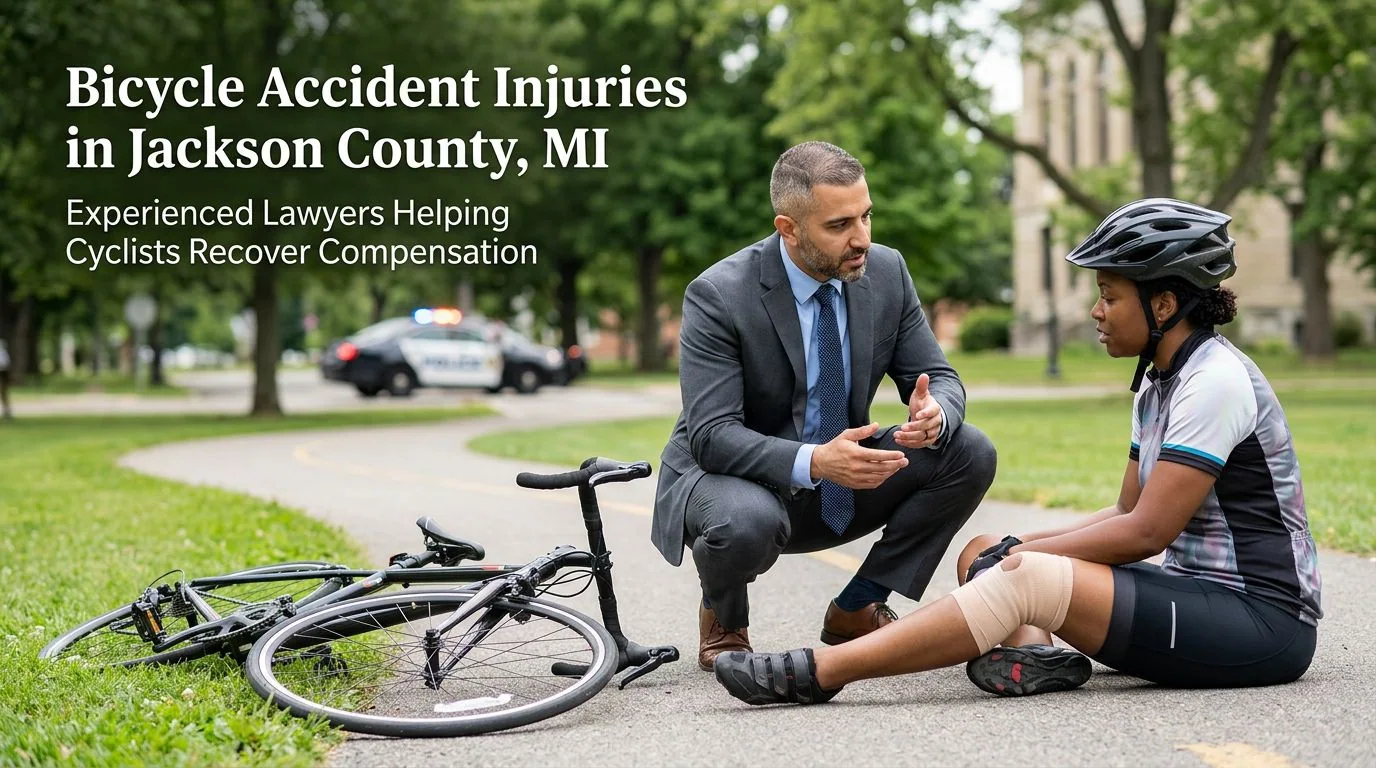
Bicycle accidents in Jackson County can involve several record sources and insurance questions. Start with the incident location, available reports and any insurer correspondence. The guidance below connects those details with the evidence needed to review the particular claim.
Preserve the bicycle, helmet, original photographs, lane markings and witness information. Identify the investigating agency and any motor vehicle involved; do not infer insurance priority from the collision location alone.
Common Causes Bicycle Accidents
Most bicycle accidents in Jackson County stem from driver negligence. Despite Michigan's efforts to improve cycling safety, distracted and careless motorists continue to pose deadly risks to cyclists sharing the road.
Common causes include:
- Distracted driving from cell phone use, texting, or other distractions
- Failure to yield to cyclists at intersections or in bike lanes
- Unsafe turns without checking for cyclists
- Dooring incidents when drivers open car doors into a cyclist's path
- Following too closely or passing without adequate clearance
- Drunk or impaired driving
- Failure to obey traffic signals and stop signs
While cyclists must follow traffic laws, the overwhelming majority of bicycle-car collisions result from motorist negligence. When a driver's carelessness injures you, Michigan law provides multiple avenues for compensation.
Your Rights Under Michigan's No-Fault System
Michigan's no-fault auto insurance system applies to bicycle accidents when a motor vehicle is involved. As an injured cyclist, you're entitled to Personal Injury Protection (PIP) benefits that cover:
- All reasonable and necessary medical expenses
- Wage loss benefits (up to 85% of gross income)
- Replacement services for household tasks you can no longer perform
- Attendant care if your injuries require in-home assistance
You file for these benefits with the auto insurance covering the vehicle that struck you. If that driver was uninsured, you file with your own auto policy. If you don't own a car, you file with the Michigan Assigned Claims Plan.
Suing the At-Fault Driver for Full Compensation
Beyond no-fault benefits, Michigan law allows you to pursue a third-party lawsuit against the negligent driver if your injuries meet the "serious impairment of body function" threshold. This requires proving an objectively manifested impairment of an important body function that affects your general ability to lead your normal life.
- Pain and suffering compensation
- Excess economic damages beyond PIP limits
- Reduced quality of life
- Permanent scarring and disfigurement
- Loss of enjoyment of activities
Our attorneys have extensive experience proving threshold injuries and maximizing third-party recoveries for Jackson County cyclists. We fight to hold negligent drivers accountable for the full scope of harm they've caused.
Documenting the incident location
Certain Jackson County roads and intersections pose heightened risks for cyclists. High-traffic corridors, roads lacking adequate shoulders, and intersections with poor visibility increase the likelihood of serious accidents. If infrastructure defects or poor road maintenance contributed to your crash, additional parties beyond the driver may share liability—including municipalities and road commissions.
We investigate every aspect of your accident to identify all sources of compensation and all parties who share responsibility for your injuries.
What to Do After a Bicycle Accident
The steps you take immediately after a bicycle accident can significantly impact your ability to recover compensation:
- Call 911 to report the accident and request medical attention
- Document the scene with photos of your bicycle, the vehicle, road conditions, and visible injuries
- Exchange information with the driver and obtain insurance details
- Identify witnesses and get their contact information
- Seek immediate medical care even if injuries seem minor—some serious conditions don't manifest immediately
- Report the accident to the appropriate insurance company within one year
- Contact an experienced bicycle accident attorney before giving recorded statements to insurance adjusters
Insurance companies routinely minimize bicycle accident claims or argue that cyclists share fault. Don't navigate this process alone.
Record resources and next steps
For a traffic incident, consult Michigan State Police’s crash-report guidance and the investigating agency identified in the report.
Use the Jackson County resource hub for local record routing and consultation planning, and the bicycle accidents practice guide for the broader claim explanation.
Discuss your claim
Logeman & Iafrate, P.C. serves Michigan injury clients from 2950 S. State Street, Suite 400, Ann Arbor, MI 48104. Call (734) 994-0200 or request a free consultation. Describe the incident, available records and any insurer correspondence. Confirm consultation arrangements before traveling.
Our published verdicts and settlements identify the matters described there. Read the claim type and venue as stated; a result does not establish local experience in another place or predict another case’s outcome.
Frequently Asked Questions About Bicycle Accidents
What should I do immediately after a bicycle accident?
First, call 911 to report the accident and request medical attention even if injuries seem minor. Document the scene with photos of your bicycle, the vehicle, road conditions, and visible injuries. Exchange information with the driver and obtain insurance details. Identify witnesses and get their contact information. Seek immediate medical care—some serious conditions like concussions don't manifest immediately. Report the accident to the appropriate insurance company within one year to preserve your benefits. Contact an experienced bicycle accident attorney before giving recorded statements to insurance adjusters.
Can I recover compensation if I wasn't wearing a helmet during my bicycle accident?
Yes. While wearing a helmet is strongly recommended and can reduce injury severity, not wearing one doesn't automatically prevent you from recovering compensation. Michigan follows comparative negligence principles, meaning your recovery may be reduced if the jury finds you partially at fault—but only if your lack of a helmet actually contributed to your injuries. Most bicycle accident cases focus on driver negligence as the primary cause, not helmet use.
How does Michigan's no-fault insurance work for bicycle accidents?
Insurance eligibility and priority depend on the injured person, motor-vehicle involvement and applicable policies. Preserve every potentially relevant policy and have the coverage order reviewed rather than assuming that the striking vehicle’s insurer is always responsible.
Can I sue the driver who hit me while I was cycling?
Preserve the bicycle, helmet, original photographs, lane markings and witness information. Identify the investigating agency and any motor vehicle involved; do not infer insurance priority from the collision location alone.
What if the driver who hit me was uninsured or underinsured?
If the at-fault driver has no insurance or insufficient coverage, you may still recover compensation through your own uninsured/underinsured motorist (UM/UIM) coverage if you carry it on your auto policy. For PIP benefits, you would file with the Michigan Assigned Claims Plan if you don't own a vehicle. Our attorneys help Jackson County cyclists navigate these complex scenarios and identify all available sources of compensation.
How long do I have to file a claim after a bicycle accident?
You must report your accident to the appropriate insurance company within one year to preserve your no-fault PIP benefits. For third-party lawsuits against the at-fault driver, Michigan's statute of limitations is generally three years from the accident date. However, these deadlines can vary based on specific circumstances. Consulting an attorney promptly ensures you meet all deadlines and preserve your rights to compensation.
Awards and Honors



We Stand with You through the Hardest Times, Advocating Vigorously for Your Rights.
At our personal injury law practice, we are prepared to handle claims involving car, truck, bus, bicycle, and pedestrian accidents; slip-and-falls and other premises liability claims; product liability claims; claims for compensation for brain and spinal cord injuries; and claims and lawsuits for wrongful death.
We help clients in Ann Arbor, Detroit and throughout Michigan recover the benefits they need and deserve. Our commitment to service is absolute. Please feel free to contact our firm at any time for advice or help with your personal injury claim.

What Our Clients Say About Us
Cases won, lives changed, and we are happy to have helped each one of our clients.



Schedule a Free Case Review with a Lawyer
Don't face this alone. Let us review your case and show you what's possible. We never charge legal fees unless we recover damages on your behalf and the initial consultation is free as well. Reach out to us today.